
What is physical AI?AI with a physical body begins to work in the real world.
Physical AI is an area of AI that recognizes the real world and works by moving the body. Unlike AI, which generates text and images on a screen, it needs to produce results in a reality with physical laws and uncertainties. EmplifAI is working on social implementation in this area through the development of our own humanoid OpenShell.
Consult about physical AI development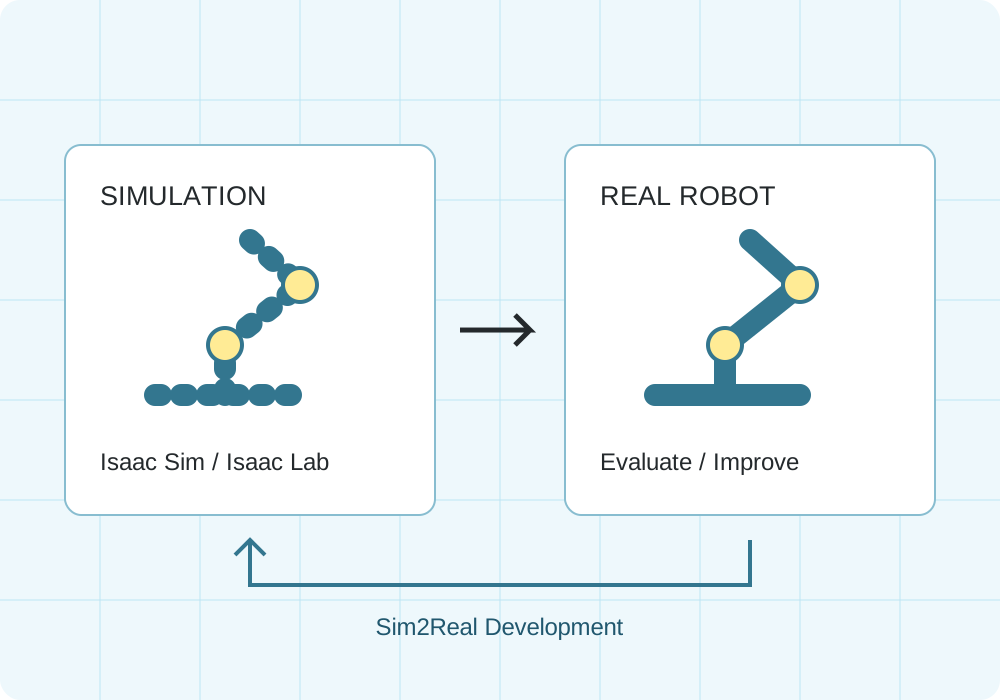
Meaning of physical AI
Physical AI is a term that refers to AI that recognizes the real world, makes decisions, and works through the body. It captures its surroundings with cameras and distance sensors, decides what action to take next, and moves its arms, wheels, and legs to affect objects and people. It may be easier to understand if you rephrase it as "AI with a body."
The reason why it has rapidly attracted attention in recent years is that large-scale models can now be applied to robot control. Until now, robot movements had to be programmed in detail by humans for each task. In physical AI, it is becoming more realistic to learn actions by showing people what they are doing, or to generate actions from verbal instructions.
However, this area is not as easy as generative AI. If you are generating sentences, even if you get some strange output, you can just rewrite it. The real body cannot be remade. It can break if you drop something on it, and it can be dangerous if you hit someone. The difficulty with physical AI lies in ensuring that it works in this "irreversible" situation.
Differences with generation AI
Even with the same AI, the required technology and evaluation methods will differ depending on the target.
The object to be dealt with is reality.
The input and output of generation AI is data. The output of physical AI is physical movement, which depends on conditions such as friction, weight, deflection, and slippage. The same instructions will not produce the same results every time.
The cost of failure is high
You can rewrite the text, but you can't get back what you dropped. Ensuring safety and reproducibility is as important, if not more important, than performance.
Not enough training data
Unlike the large amount of text and images available on the Internet, you have no choice but to collect robot movement data yourself. Data collection itself is a big part of development.
No delays allowed
Control has a fixed cycle. If the response is delayed, the posture will collapse and the movement will fail. Balancing the amount of calculation and response speed is a design constraint.
Evaluation depends on the field
The success rate in the actual field is more meaningful than the benchmark numbers. If the environment changes, such as lighting, floor surfaces, and people's movements, the results will change as well.
Inseparable from the design of the body
What you can learn changes depending on what kind of hand you use and how many degrees of freedom you have. Software cannot be developed in isolation.
Technology supporting physical AI
This is the elemental technology that EmplifAI is actually working on.
- imitation learning
- A method for learning robot movements from demonstrations of tasks performed by humans. Instead of writing down the movements in a program, we teach them through demonstration.
- VLA(Vision-Language-Action)
- A model that connects visual and linguistic understanding to action generation. Decide the next action based on verbal instructions and the situation in front of you.
- Sim2Real
- A method of transferring control learned and verified through simulation to the robot. A design that takes into account differences such as friction, mass, sensor error, and communication delay is required.
- Remote control/telepresence
- Technology that transfers an operator's physical movements and intentions to a robot in real time. It can be used both for actual operation before automation and for collecting learning data.
- Collection of training data
- The process of designing the target work, equipment, collection volume, and quality standards, and acquiring data using the robot. This will be the foundation for physical AI development.
- ROS 2 / LeRobot
- A foundation used to implement robot control and learning. Design including connection with existing robot SDK.
Application to humanoids
Humanoids are attracting attention as a potential source of physical AI. The reason is simple: you can use the environment created for people as is. The difference from dedicated machines is that it can be brought to the site without installing new dedicated equipment.
OpenShell, developed by EmplifAI, is a 28-axis humanoid that combines an expressive head, dual arms, and a trolley. I chose this configuration in order to study both the ability to work and how to interact with people at the same time. Having a face makes it easier for people to talk to you and conveys your intentions. Although this does not appear in the performance table, it is definitely effective in the workplace where people are present.
When implementing something, it is more realistic to start with remote control and gradually expand the scope of automation, rather than aiming for complete automation from the beginning. Learning data is accumulated as the site is operated remotely, and this data becomes the material for automation.
Support for physical AI development
OpenShell
A humanoid developed in-house. The specifications as a research and development platform are listed.
Sim2Real development support
Development support from simulation to robot verification using NVIDIA Isaac Sim/Isaac Lab.
Robot learning data collection contract
We undertake the collection of data necessary for imitation learning and operation verification, from condition design to delivery.
Robot learning data acquisition kit
We will propose the configuration of the data acquisition environment, including remote control equipment, cameras, and recording PCs.
Robot SI/Introduction support
We provide consistent support from the selection of AI robots to their introduction and operation.
Achievements/case studies
We are posting initiatives such as imitation learning, VLA implementation, and remote/body-sharing telepresence.
Frequently asked questions
What is the difference between physical AI and robotics?
Robotics refers to robotics in general, including mechanisms, controls, and sensors. Physical AI is a term that emphasizes the role of AI in recognizing the real world and determining actions. The two are not contradictory; physical AI is built on robotics.
Can physical AI be used in practice right now?
It depends on the purpose. Although there are still many issues to be solved before completely replacing human work, it can be put into practical use at this point in applications where "interacting with people" itself is valuable, such as customer service, guidance, and attracting customers, and in operations that involve remote control.
Can you make robots learn your work?
It depends on the target work. First, organize your work and see if you can obtain demonstration data and define evaluation metrics. It is safe to start with a PoC focused on one task. If you let us know the target work and current situation, we will suggest how to proceed.
How much training data do I need?
It depends on the difficulty of the task, the degree of variation in the environment, and the desired success rate. We first conduct test collection, determine the required quantity and quality standards, and then proceed to actual collection.
Which robot should I start with?
For research and development, it will be easier to use models and SDKs that are compatible with secondary development. We will propose robot that are actually used in verification, such as Unitree G1 and OpenShell. You can also rent it and try it out before deciding.
Consultation on physical AI development
Please let us know the target robot, the work you want to accomplish, and your current development environment. You can consult with us even when requirements and technology selection have not been decided. It is also possible to start with a PoC for one task.
Consult about physical AI development