
OpenShellBuilt to work with people.
A face to connect.
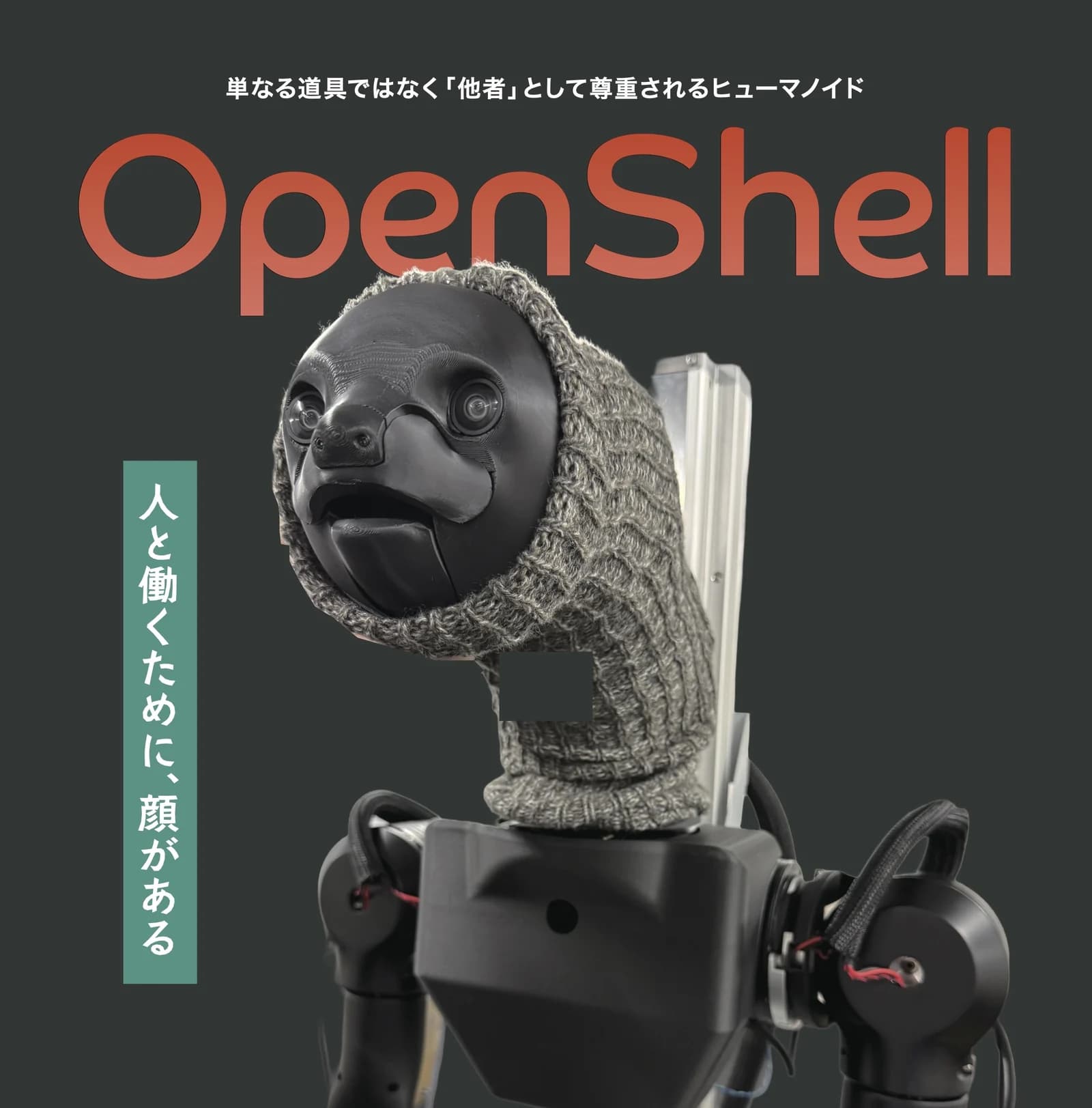
A humanoid designed to be respected as a counterpart, beyond being a tool.
An open-source-based robot that combines dual-arm manipulation and mobility with communication through head orientation, facial expressions, and voice. Equipped with a display, speaker, and microphone, it can also support customer service, guidance, and conversation.
Patrol, guidance, reception, and remote support on site.
We design the robot configuration, operation, and software for your facility or event. See movement, conversation, dual-arm work, and teleoperation at our Yushima demo.
The ability to work. Expressions that connect.
Convey your intentions with your face and voice
The sloth-inspired head has a two-degree-of-freedom facial mechanism for mouth corners and mouth movement. It also includes a display, speaker, and microphone, enabling customer service, guidance, and conversation through head orientation (pan and tilt), expressions, voice, and on-screen information.
Built for researchers to customize
Replace or add heads, hands, sensors and AI to suit your research. OpenShell aims to provide a platform for evaluating and extending your own AI, control systems and hardware.
Evolving with research results
Publicly available ROS 2 packages and interfaces will be gradually opened. We aim to be a platform that is improved and expanded together with the research community.
Facial expressions and intention presentation are HMI (human-machine interface) independent of safety functions. The aim is to increase the predictability of behavior and improve acceptability and ease of introduction in interpersonal environments.
Video of the robot in action.
You can see the actual OpenShell exhibit, a different head design, and a demonstration of remote control.
Bilateral leader arms provide force feedback. For precise tasks, precision mode reduces the robot’s movement relative to the operator’s input. VR controller operation is also supported.
Media coverage
We showed the prototype at the Physical AI Summit. These are the broadcasts and articles that covered OpenShell.
- September 16, 2026
- TV Tokyo “World Business Satellite”OpenShell was introduced in the special feature of Physical AI Summit.
- September 17, 2026
- MONOist|7 companies compete in physical AI data collection using domestic general-purpose robots, unveiling prototypes ↗OpenShell has been featured as a robot with a face.
- September 17, 2026
- Robostar | Prototypes from 7 domestic general-purpose robot companies unveiled at once, moving forward with physical AI implementation ↗It is published along with comments from the representative, Osone.
Adapt the platform
to your research.
Built on open-source hardware, the platform supports extensions to both its physical capabilities and intelligence.
- Actuated axes / AXES
- 28 actuated axes in total: 4 in the head (pan, tilt, mouth corners, and mouth opening/closing) + 7 per arm × 2 + 1 per gripper × 2 + 8 in the mobile base.
- Head
- A custom-designed, replaceable and expandable head. Its stereo camera enables stereoscopic viewing through VR headsets or 3D displays. Cameras, displays and facial mechanisms can be customized for your research. The head was designed by artist Takayuki Todo.
- Interaction / INTERACTION
- Equipped with a display, speaker, and microphone. By combining facial expressions, head orientation, voice, and on-screen information, it can support customer service, guidance, and conversation.
- Arms
- A dual-arm configuration based on OpenArm 01. The arms are mounted in the reverse orientation so the elbows project forward, making it easier to work in front of the robot. It can hold a 2 L plastic bottle in one hand. New hands and AI can be integrated for research into manipulation and control.
- Mobile base
- A mobile base built on TidyBot++. Each of its four wheels has two actuated axes for steering and wheel rotation, for a total of eight axes supporting three degrees of motion: forward/backward, sideways, and turning. An optional 3D LiDAR enables autonomous navigation. It supports research combining mobility and manipulation.
- Software
- Compatible with ROS 2 / SDK / LeRobot. It has a configuration that allows connection of proprietary VLA, imitation learning, reinforcement learning (RL), and various sensors.
Turn tasks and interactions into training data.
Synchronized recording of visual, behavioral, dialogue, and non-verbal information. Data is accumulated not only during movements, but also during the presentation of intentions and responses, allowing for evaluation, learning, and improvement of both work ability and interpersonal interaction.
Perform tasks in the real world
Use teleoperation to capture robot movements and human interaction in real environments.
Record in sync
Record images, movements, conversations, and non-verbal expressions at the same time.
Evaluation/Learning/Improvement
Evaluate work ability and interpersonal interaction and use it for future learning and improvement.
OpenShell: sales, development and media inquiries
If you are considering introduction, research use, joint development, or reporting, please let us know the purpose, desired configuration, and timing.