
Robot Site Assessment Diagnosis of suitability for on-site implementationCheck the conditions to see if the candidate robot can move and work on the site.
At sites where robot introduction is being considered, we investigate aisles, doors, steps, elevators, work spaces, communication environments, etc., and organize conditions that suit the robot and task. We do not unconditionally guarantee the safety of the site or whether or not it can be introduced, but we report the results of our investigation, including the scope of confirmation and unconfirmed matters.
Robot Site Assessment Consult about on-site installation feasibility diagnosis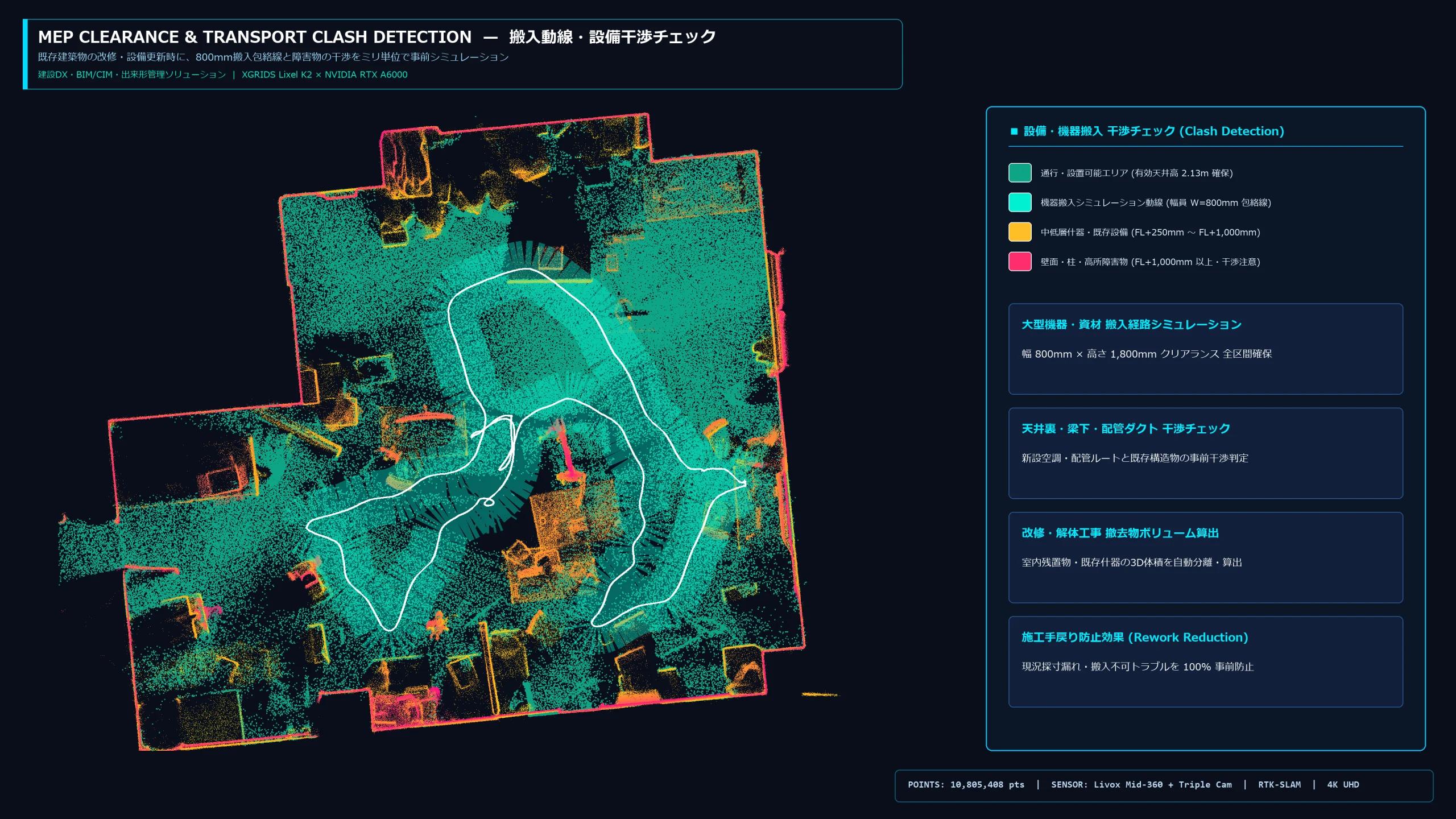
3D digital twin with 10.8 million measured points that can be moved 360° on the browser
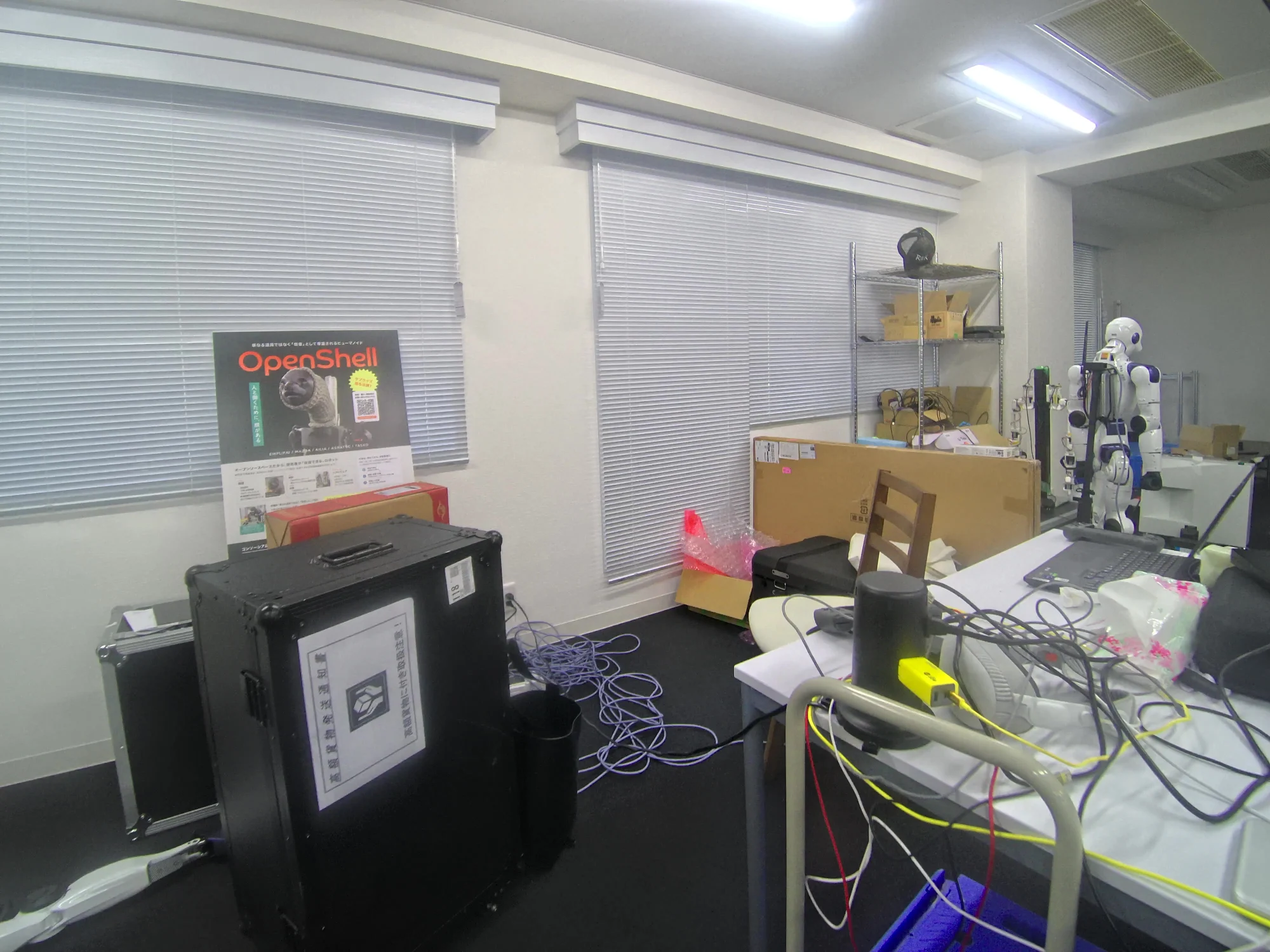
This is actual data measured while walking in EmplifAI's robot development lab (Unitree G1 humanoid/double-arm robot installation environment) for just 89 seconds using our own XGRIDS Lixel K2. In addition to being able to rotate and zoom 360° by dragging or swiping the mouse, you can experience switching between four display modes, ceiling slicing (cross-sectional cutting), and viewpoint jump to the robot installation spot on the spot.
What can be done with XGRIDS 3D spatial data × physical AI?
The greatest value of 3D scanning a site is not just in creating drawings for human viewing. By combining millimeter-level 3D spatial data with EmplifAI's humanoid robots (Unitree G1, etc.), dual-arm manipulators (OpenArm), VLA models, and the NVIDIA Isaac Sim environment, everything from pre-diagnosis for robot introduction to virtual training, autonomous movement, and remote control will change dramatically.
Digitize real space in 89 seconds and create a virtual verification environment where humanoid and dual-arm robots move
Even in factories, warehouses, and research facilities where drawings do not exist, you can obtain 3D point clouds and live-action textures of the entire room by simply walking around with XGRIDS Lixel K2. In the actual measurement data of the EmplifAI lab, the entire space (68.3 m2, 10.8 million points), including the humanoid by the window (Unitree G1) and the dual-arm robot work cell in the center, was converted into spatial data in just 89 seconds. By importing the acquired space into the NVIDIA Isaac Sim or ROS 2 environment, you can run simulations (Real2Sim2Real) of walking routes, whole body control, and grasping motions before bringing the robot to the site.
What can be achieved with this combination
- Build a full-scale 3D virtual space where humanoids and AMRs run and work by simply walking around the site.
- Collision detection model and navigation map conversion cooperation for NVIDIA Isaac Sim, USD, and ROS 2
- Environment generation for robot reinforcement learning and imitation learning that directly reflects on-site fixtures, workbenches, and obstacles
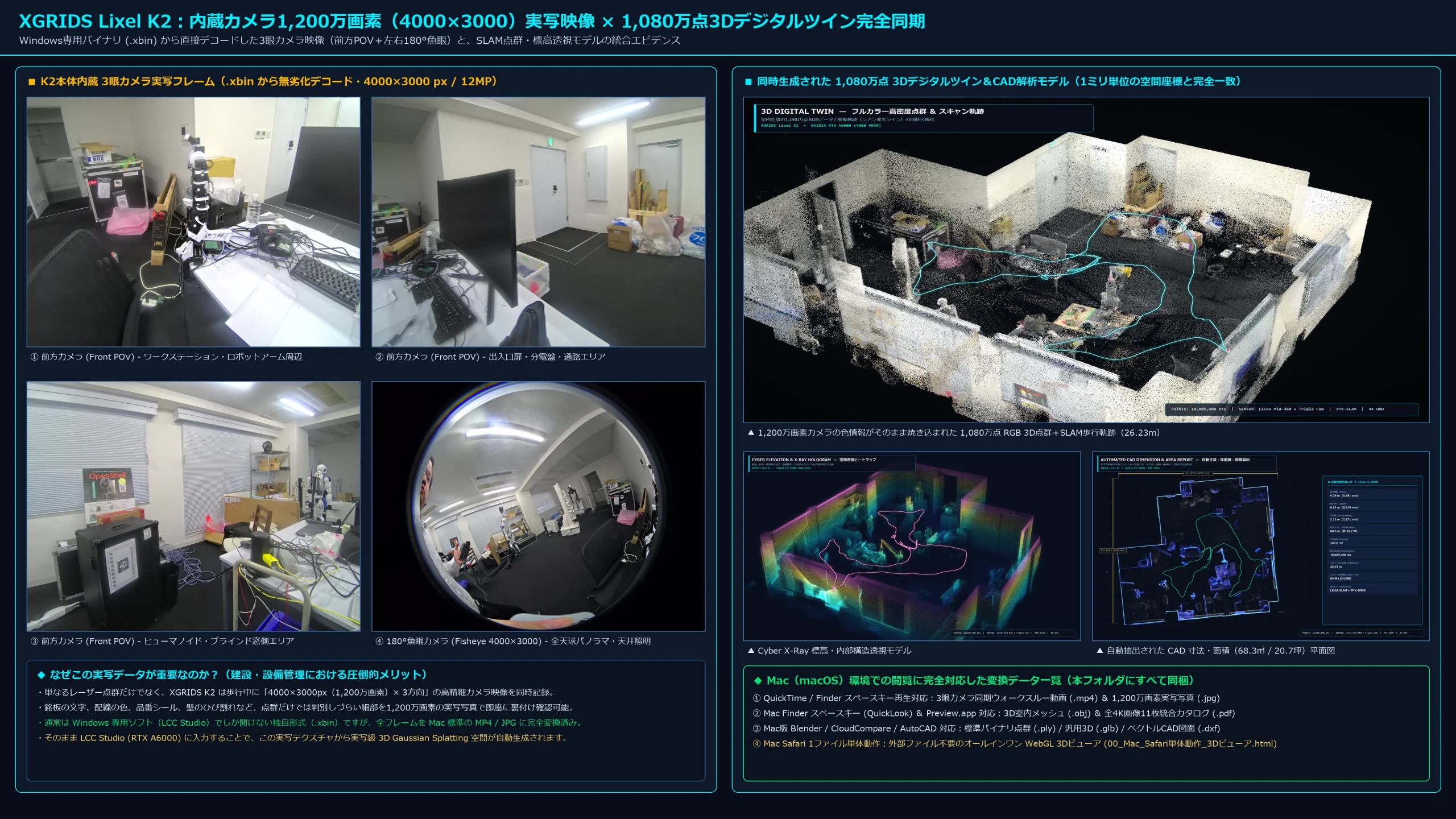
Watch the video: From an 89-second walkthrough to the creation of a 3D space with 10.8 million points
You can switch between the 360° multimodal analysis video of the lab space actually measured with XGRIDS Lixel K2 and the 10.8 million-point spatial build-up video created by laser scanning.
360° rotation × 3 modes continuous change (Full color RGB → Cyber elevation → LiDAR X-Ray)
This is a showcase video that rotates 10.8 million points of 3D spatial data generated from a single walking scan (89 seconds) and displays it in 360° rotation while seamlessly switching between three modes: live-action full color RGB, cyber elevation hologram by height, and X-Ray perspective based on laser reflection intensity.
"4K spatial analysis/drawing/inspection visualization" that can be developed from multiple angles from a single scan
From the acquired high-density 3D data to full-color point clouds, elevation holograms, 1m grid architectural ortho diagrams, CAD floor plans with automatic dimensions, millimeter heat maps of floor unevenness and wall verticality, and robot delivery clearance verification, you can develop analysis views that suit your purpose. Click on the thumbnail to switch, and click on the image to enlarge in high resolution.
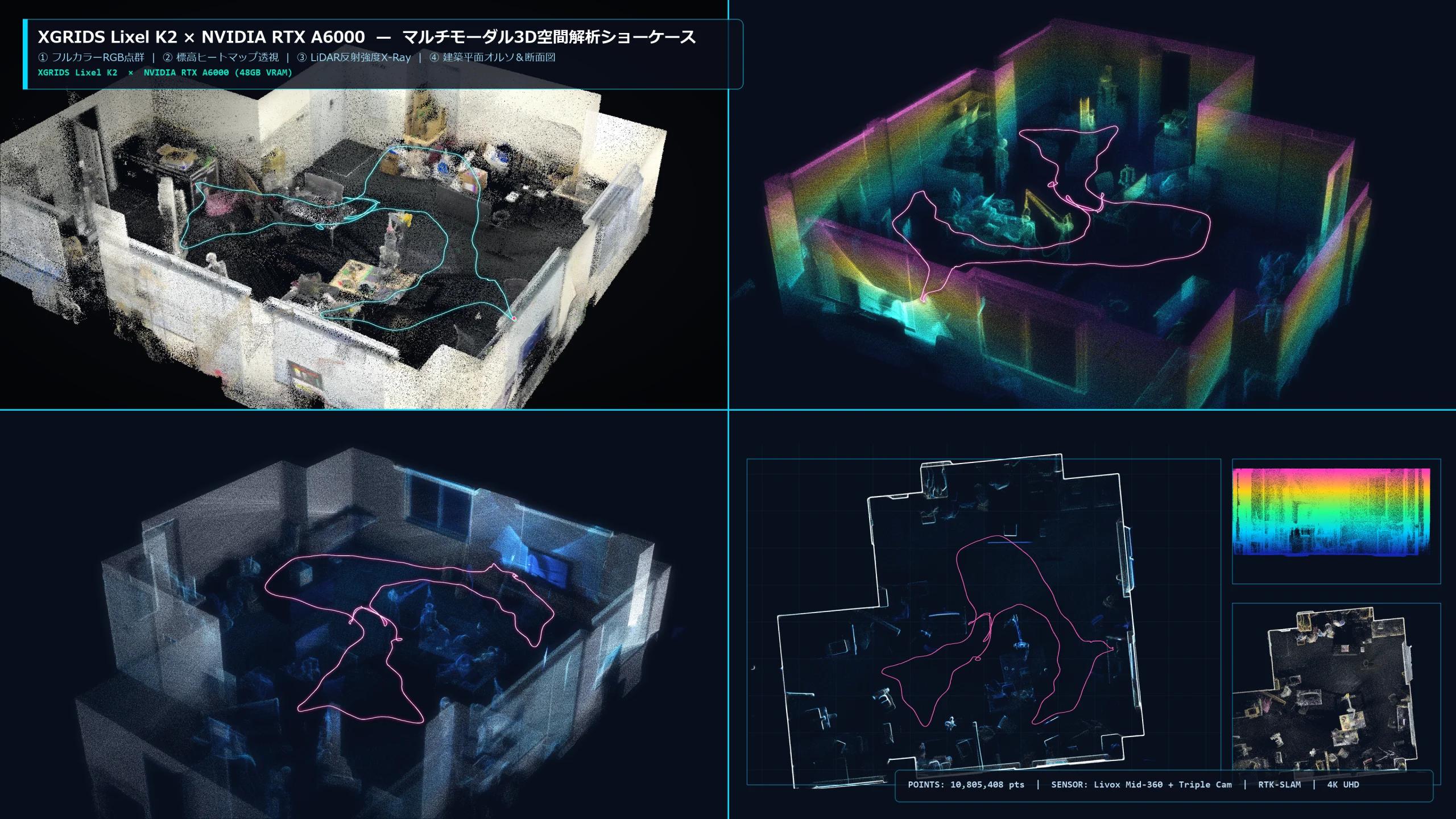 Click to enlarge 4K high-definition image
4-division multimodal 3D spatial analysis showcase
From one scan data, four modes can be simultaneously developed: (1) full-color RGB point cloud, (2) elevation heat map perspective, (3) 1m grid architectural orthoplan, and (4) cross-sectional profile. You can understand the appearance, dimensions, and structure of the space at a glance.
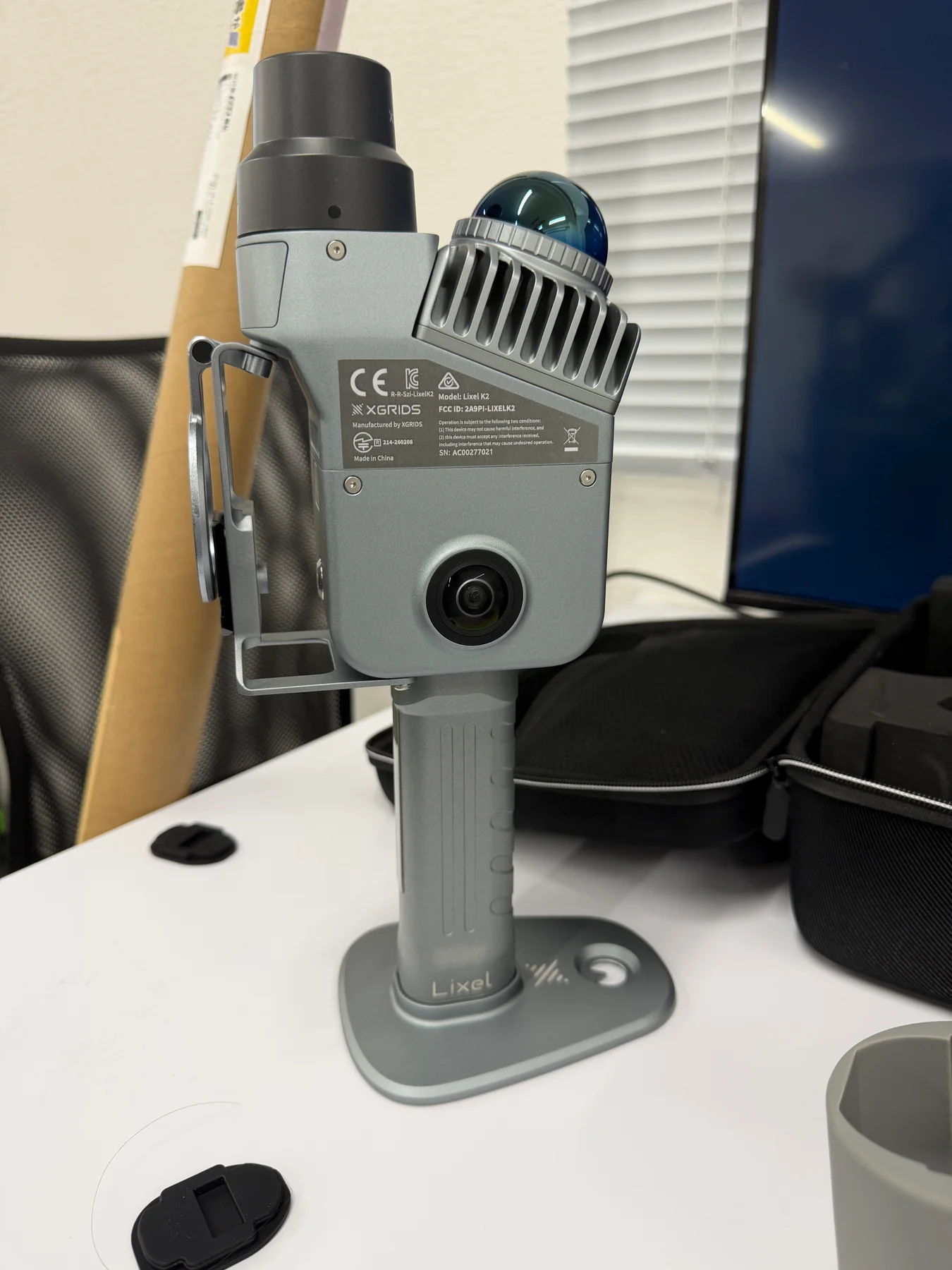
We have an actual XGRIDS Lixel K2 and provide comprehensive support from 3D spatial measurement to physical AI collaboration.
EmplifAI has installed an actual XGRIDS handheld 3D scanner "Lixel K2" and a workstation GPU "NVIDIA RTX A6000" with a large capacity VRAM of 48GB in its own laboratory. We can create a 3D digital twin of the entire room (68.3 m2, 10.8 million points) in just 89 seconds of walking, and provide comprehensive consultation on everything from point clouds, CAD/BIM drawings, and floor unevenness inspections to 3D Gaussian Splatting (3DGS) and humanoid and dual-arm robot simulation (NVIDIA Isaac Sim/Real2Sim) collaboration.
K2's 3D digital twin, robot, and physical AI collaboration
XGRIDS Lixel K2 special showcase page
We will introduce you to an interactive 3D viewer with 10.8 million points, 4K spatial analysis, physical AI collaboration, on-site measurement and rental consultation.
Consultation content and deliverables
- Dimensions
- Passage width, door width, steps, slope, work/turning space
- equipment
- Confirm the scope of agreement, including elevators, floors, power supplies, and delivery routes.
- Connectivity
- Check the connection conditions such as Wi-Fi in the target area. Radio wave quality is not guaranteed.
- Deliverables
- Report summarizing investigation conditions, suitability, constraints, and additional confirmation items
- price
- Individual estimates depending on the number of sites, target area, and survey items
How we work
We will ask you about the current situation, target robot, site conditions, and desired timing, and then we will begin work after agreeing on the scope of implementation and preconditions. Deliverables and prices will be specified in the individual quotation.
Frequently asked questions
Robot Site Assessment What can I request for on-site installation feasibility diagnosis?
At sites where robot introduction is being considered, we investigate aisles, doors, steps, elevators, work spaces, communication environments, etc., and organize conditions that suit the robot and task. We do not unconditionally guarantee the safety of the site or whether or not it can be introduced, but we report the results of our investigation, including the scope of confirmation and unconfirmed matters. The specific scope of the project will be agreed upon before the start of the project after confirming the robot, site, and desired deliverables.
Robot Site Assessment How are the costs and delivery scope determined for on-site implementation feasibility diagnosis?
We will confirm the target robot, number of machines, implementation location, and required deliverables, and provide an individual estimate of availability, scope of work, completion conditions, and cost.
Robot Site Assessment Consultation on on-site installation feasibility diagnosis
Please let us know the target robot, location, issue you would like to solve, and desired timing. We will inform you about the implementation details and estimate.
Robot Site Assessment Consult about on-site installation feasibility diagnosis