
Robot remote operation and teleoperationBefore full autonomy, a person operates it and the site keeps running.
Remote operation is how you put a robot on site without waiting for automation. EmplifAI has implemented body-sharing telepresence that transfers the operator's motion and intent to a humanoid in real time, with force feedback and VR controller operation.
Discuss remote operation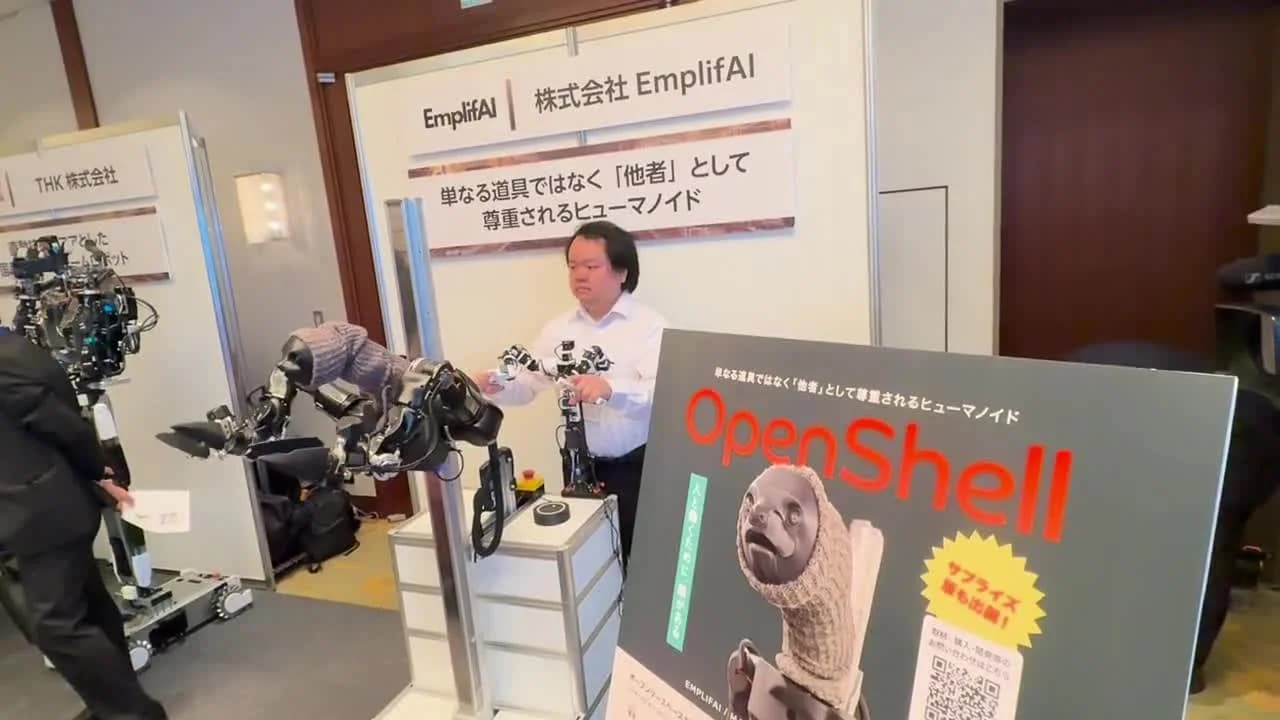
Get it usable on site before automating
The cost of a robot deployment balloons most when full autonomy is the goal from day one. Try to handle every unforeseen situation and the development never stops growing.
Remote operation reverses that order. A person operates and the site runs. The work actually happens while the initial cost stays down, and you find out what really occurs there. The record of that operation then becomes training data, and the material for automation.
There is value apart from automation, too: people no longer have to stand in a dangerous place, and a specialist far away can operate in place of whoever is on site.
What we have implemented
Whole-body motion transfer
We have implemented remote, body-sharing telepresence that transfers the operator's motion and intent to a humanoid in real time.
Force feedback
A bilateral leader arm returns the feel of the grasped object to the operator. It tells in work that needs force control.
Precision mode
Lowering the robot's motion ratio against the operator's lets you verify fine work. It can be switched with large-movement tasks.
VR controller operation
Configurations without a leader arm are supported too. Choose by use and by who will operate it.
Combined with automation
Routine motion runs automatically and a person takes over where judgement is needed. Designing the hand-over conditions can be discussed too.
Synchronised recording of training data
Vision, action, dialogue and non-verbal signals are recorded in sync while operating, and kept in a form that can be used for learning as it is.
What to check when considering it
- Precision and force in the target task
- How much positional error is tolerated, and whether pressing or fitting is involved. This is where the need for force sensing is decided.
- Distance between operator and site
- Same site or remote. Distance feeds straight into the network conditions and the latency design.
- network
- Both video and control have to get through. We check the site's connection in advance.
- person operating
- Who operates, and how many are needed. The time it takes to become proficient is part of the operational design too.
- Safety conditions
- Stop conditions on operator error, and distance from people. We design on the premise that, being remote, you cannot see the site.
- Handling of recordings
- Whether to keep it as training data. If so, we decide the recording scope and the storage conditions.
Frequently asked questions
Which robots can be operated remotely?
Besides our own OpenShell, any machine controllable through ROS 2 or a vendor SDK can be discussed. Tell us the machine and the task and we will propose what can be implemented.
Can it be operated from a remote location?
It depends on the network. Both video and control have to get through reliably, and heavy latency makes precise work difficult. We check the site's connection and propose an arrangement that works.
Is force feedback essential?
It depends on the work. It helps where feel matters, such as pressing or fitting, but a VR controller can be enough if the job is just picking up and carrying. We judge from the task.
Can we move from remote operation to automation?
That is the standard route. The data recorded while operating becomes material for imitation learning and VLA, and automation spreads outward from the routine parts. It reaches a usable state on site sooner than aiming for full autonomy from the start.
Discussing remote operation and teleoperation
Tell us the task to operate, the target robot, and the distance between operator and site. We will propose a route that includes the move to automation.
Discuss remote operation