
Humanoid robot developmentA team that has built one builds yours.
A team that develops humanoids in house takes on building machines. EmplifAI handles its dual-arm mobile humanoid OpenShell from design through machine integration, and was selected as consortium lead for the domestic general-purpose robot development competition run under a NEDO commission.
Discuss development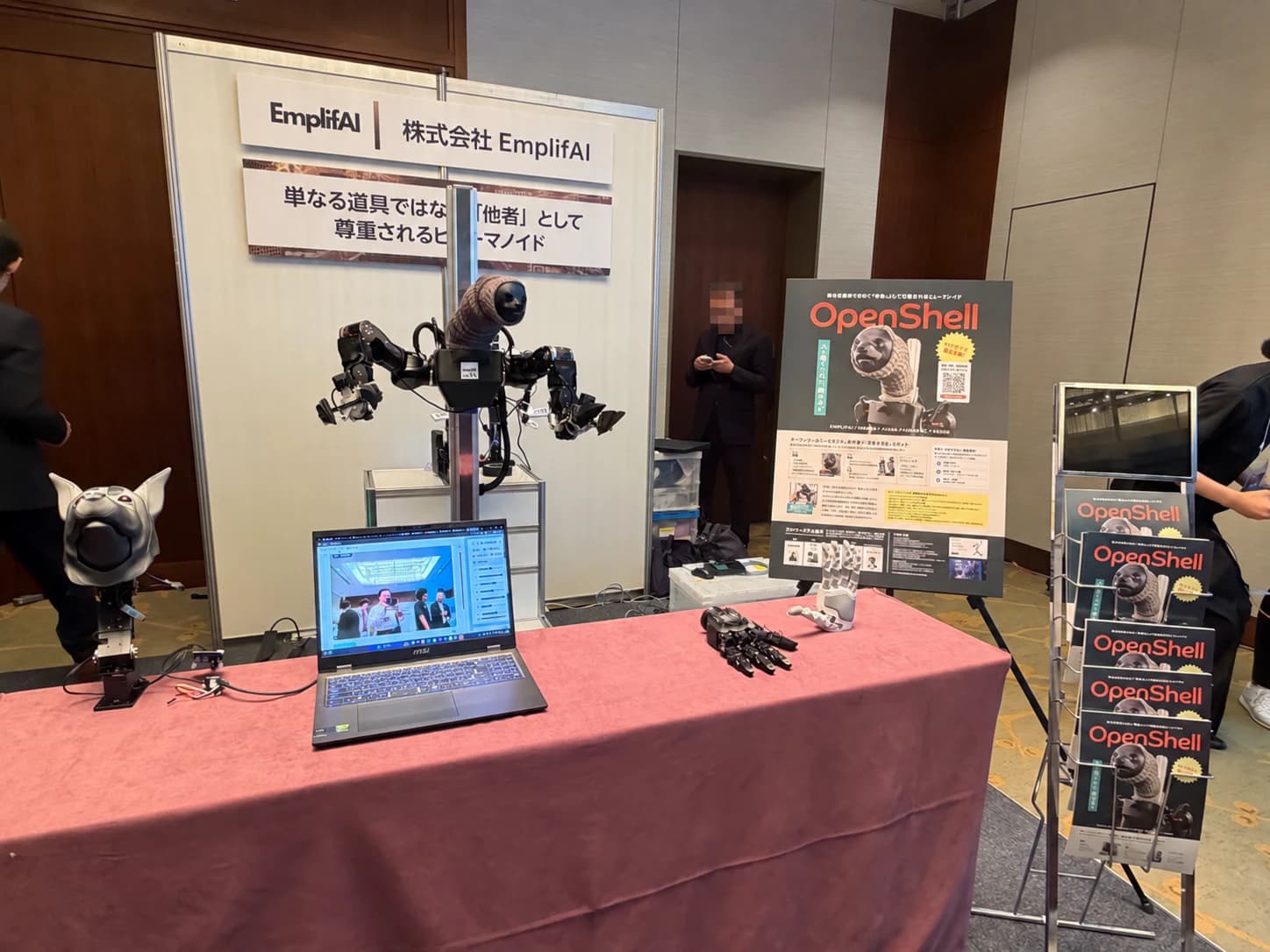
Can they show you something that moves, before the spec sheet
The hardest part of outsourcing humanoid development is landing on a partner who can write a proposal but has never built a machine. With a humanoid, if the mechanism, control, sensing or AI breaks anywhere, none of it moves. Plenty of designs work on paper and still will not stand up.
EmplifAI develops OpenShell in house. Twenty-eight axes across head, dual arms, grippers and base, built on OpenArm 01 and TidyBot++, down to decisions like mounting the arms in reverse so the elbows come forward — all settled by actually building it.
So we can take the conversation before the requirements are fixed. If you know what you want it to do, we define the degrees of freedom and the configuration with you from there.
What we can take on
Requirements and configuration design
From the work you want to hand over, we define the degrees of freedom, payload, reach, drive method and sensor set. That includes judging whether modifying an existing machine is enough.
Mechanical design and prototyping
From dual-arm and mobile base design through to a prototype. Building on open-source hardware can cut both the schedule and the cost.
Head and human interaction
Expression mechanism, display, speaker, microphone. If it is to work in the same space as people, a way of conveying intent tells as much as performance does.
Control and motion development
Control with ROS 2 or a vendor SDK, motion generation, whole-body coordination. We have delivered development that reproduces human motions on a robot.
Learning and AI implementation
We cover implementation of imitation learning, VLA and reinforcement learning, and the design of the data collection environment behind them.
Integration and verification
Parts can work individually and still not work once integrated — that is the real machine. We take on assembly through to validation on site.
How to proceed with development
You can talk to us from the concept stage. We start by carving out the scope that confirms feasibility.
- 01 Define the use
- We make concrete what the finished machine will do and where it will be used. Leave this vague and the specification keeps growing.
- 02 Consider the configuration
- New build or modification of an existing machine. We settle the degrees of freedom and configuration, and give a view of cost and schedule.
- 03 Prototype and verify
- We narrow to a single task and confirm on the real machine where it holds. This is where the direction is fixed.
- 04 Develop control and learning
- Motion generation, remote operation and learning. How far to automate is widened in stages.
- 05 Integrate the machine
- We integrate mechanism, wiring, control and AI into something that runs end to end.
- 06 Verify on site
- We run it in the real environment and settle the conditions, staying with you through the hand-over to operations.
Frequently asked questions
Can we talk at the concept stage?
Yes, and that stage suits us best. If you know what you want it to do, we define the configuration and a realistic scope with you. Once the specification is fixed, the options narrow.
Which is better, building from scratch or modifying an existing machine?
It depends on the use. If a commercial machine is enough, modification is quicker and cheaper. New development is considered when payload, working height or human-facing requirements cannot be met by an existing machine. We organise the requirements first, then propose.
How long does the development period take?
It varies a lot with the scope. Adding a function to an existing machine takes months; designing from the mechanism up needs a corresponding period. We recommend starting from a prototype narrowed to a single task.
Who owns the rights to the finished machine?
It is agreed in the contract. Joint development, contract development and customisation of our own machine are each handled differently, so please raise it at the planning stage.
Discussing humanoid development
Tell us what the machine is for and what is already decided. A concept stage is fine. The team that develops its own machine will define the achievable scope with you.
Discuss development